

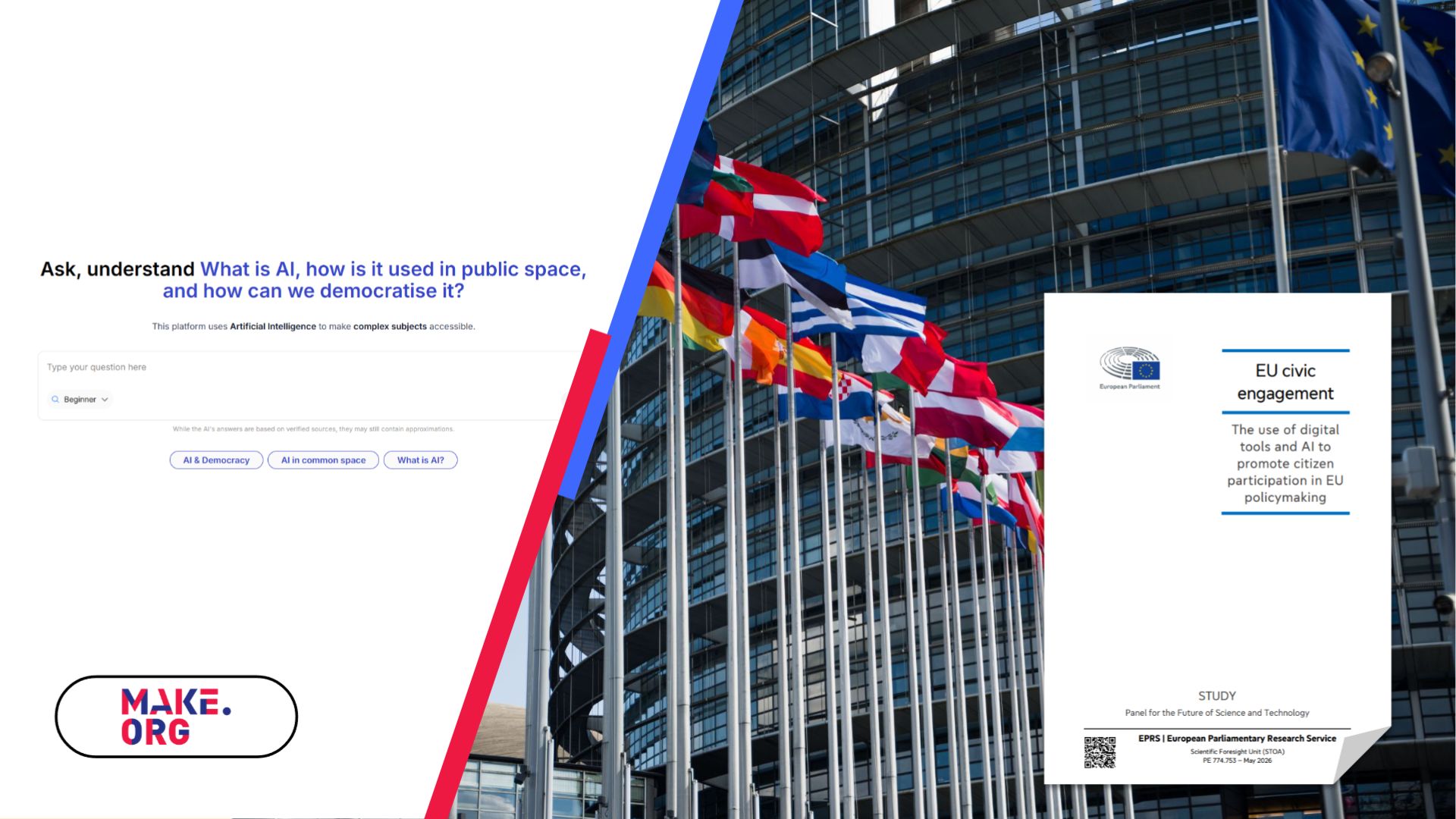
Earlier this year, the European Parliamentary Research Service (EPRS) published a study on EU Civic Engagement – The Use of Digital Tools and AI to Promote Citizen Participation in EU Policymaking. In their analysis, Panoramic was recognised as one of the emerging AI tools that meaningfully involve citizens in policymaking.
AI and Citizen Participation
Artificial intelligence(AI) is rapidly transforming many parts of society - including civic participation, a trend strongly echoed in the EPRS study. AI inevitably emerges in debates about democratic engagement, digital infrastructure, and the future of civic tech. AI and participation are becoming deeply interconnected.
This convergence is reshaping how institutions listen to citizens, how public debates are structured, and how democratic systems adapt to new expectations. It also raises new challenges that require coordinated responses. In this evolving context, Make.org’s work offers a concrete illustration of how responsible, citizen‑centred AI can strengthen democratic engagement rather than weaken it, precisely the type of approach the EPRS study calls for.
General insights from the EPRS study
The study focuses on how digital tools and AI are reshaping civic engagement across Europe. It emphasises that digital participation can strengthen democratic processes when it is anchored in clear institutional mandates, inclusive design, and robust accountability.
The report stresses that meaningful participation requires political commitment, investment, and integration into the policy cycle. It also highlights the importance of accessibility, noting that digital tools remove time and place barriers while introducing new literacy and skills requirements.
Zoom on Panoramic
Within this context, Make.org’s Panoramic is presented as a promising example. The study acknowledges its contribution to transparency by offering a unified interface through which citizens, journalists and policymakers can explore deliberations. It notes Panoramic’s ability to tailor information to different audiences, making complex institutional content more accessible, and its efficiency in automating summaries.
At the same time, the report identifies challenges inherent to generative AI. Those risks were previously anticipated and mitigated by Make.org when building Panoramic. They include the risk of inconsistent outputs, loss of nuance in automated summaries, and the need for clearer visibility on how outputs are generated.
Make.org’s Participation Ecosystem: implementing AI at the Service of Democracy
The EPRS study emphasises the need for responsible, transparent and citizen‑centred AI which is an approach embodied across Make.org’s platforms.
Use cases of Panoramic
Panoramic’s recent deployments illustrate how these principles can be put into practice.
In Germany, WahlCheck 2025, developed with the Federal Agency for Civic Education, provides citizens with clear, verified and accessible information about party platforms and political issues ahead of the federal election. The platform allows voters to ask questions, explore curated content, and navigate complex political topics with ease, strengthening informed decision‑making and democratic trust.
At the European level, Panoramic has been used for the European Research and Innovation Days 2025, offering a tailor‑made platform that enables participants and the wider public to revisit sessions, explore EU strategies, and access time‑stamped video recordings and documents. Its deployment at EuroPCom 2024 and 2025 further demonstrates its adaptability, supporting Europe’s largest gathering of public communication professionals and contributing to discussions on trust, innovation, and institutional communication.
Panoramic also powers the Democratic Digital Commons initiative led by European Alternatives, enabling citizens across Europe to engage with debates on AI, digital infrastructure and democratic governance, and contributing to the forthcoming Citizens’ Charter for Democratic AI.
Make.org: experts in AI and democracy
Make.org also contributes to Gen(Z)AI, Canada’s national youth assembly on AI, by powering a large‑scale consultation that bridges deliberation among young people with nationwide participation. The Dialogue platform enriches and prioritises recommendations for Canada’s AI strategy, demonstrating how AI can support inclusive and legitimate policymaking.
As part of the Democratic Digital Commons, a transnational initiative led by European Alternatives, Make.org used its platform Panoramic to let users explore questions at the intersection of AI, digital infrastructure, and democracy.
In partnership with ifok, Make.org convened high‑level roundtables on AI and democracy, producing a synthesis report that examines opportunities, risks, and the need for transparency, literacy and bias mitigation in democratic AI systems.
SenseMaking: AI‑Powered Analysis of Citizen Debates
Behind Make.org’s platforms lies SenseMaking, an open-source AI system designed to analyse large‑scale citizen contributions across Panoramic, Dialogue, and Consultation.
SenseMaking transforms thousands of proposals, comments, and questions into structured insights. It identifies:
Sensemaking integrates the academic research from the Democratic Commons programme, developed with SciencesPo, Sorbonne University and CNRS. The program aims to identify and mitigate the risk of AI for Democracy. For AI assisted summary of citizens debates, it means making the AI summary auditable, by splitting it in small steps verifiable by an human. Minimising the partisan bias of IA when building the summary, integrating human-in-the-loop to make sure that AI is working as intended.
Key features include:
SenseMaking embodies Make.org’s belief that AI should support democratic interpretation.
Conclusion
Across these initiatives, Make.org continues to demonstrate how responsible, transparent and citizen‑centred AI can support democratic engagement. The recognition of Panoramic by the European Parliament’s Research Service underscores both the promise and the responsibility of deploying generative AI in public institutions. It also affirms the importance of continued research, collaboration and ethical development to ensure that AI strengthens democracy and helps build a more participatory, connected and accessible European Union.