

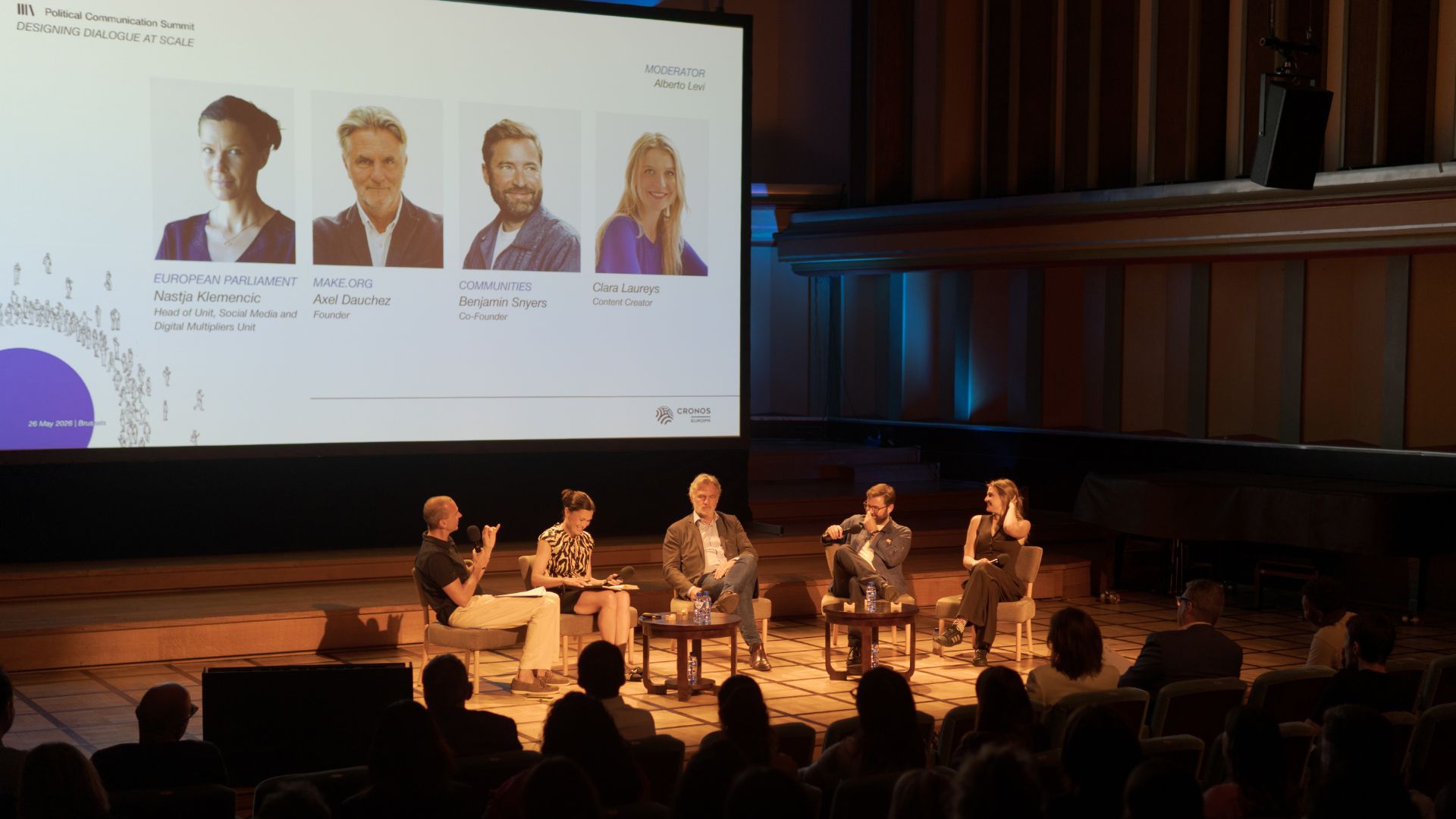
We were honoured to have our President, Axel Dauchez, participate in the Brussels Pre-event of the Political Communication Summit. The event brought together content creators, EU officials, journalists and communication experts for a thoughtful and timely discussion on trust and democratic dialogue in today’s increasingly complex digital landscape.
It was an inspiring exchange between many dedicated professionals working to strengthen the relationship between institutions, organisations and citizens.
Axel Dauchez took part in the main panel discussion, “Designing Dialogue at Scale: Reimagining Democratic Dialogue Between Europe and Its Citizens,” alongside Nastja Klemencic (Head of the Social Media and Digital Multipliers Unit, European Parliament), Benjamin Snyers (Co‑Founder of Communities) and Clara Laureys (content creator). The session was moderated by Alberto Levi, Communications Solutions Strategist at Cronos Europa.
.jpg)
The discussion converged on a shared diagnosis: traditional top‑down communication is no longer sufficient to sustain trust in European democracy. With audiences increasingly fragmented and citizens expecting to be part of the conversation rather than passive recipients of information, the panel explored how institutions can shift from broadcasting messages to enabling genuine dialogue. This shift requires not only new formats and partnerships, such as working with content creators, local communities and grassroots networks, but also a cultural change within institutions themselves. All panelists agreed that communication must become more conversational, more tailored, and more rooted in the realities of the people it aims to reach.
Axel Dauchez emphasised that technology now makes it possible to scale democratic dialogue in ways that were unimaginable a decade ago. By using AI to simplify access to political information and to engage millions of citizens around a single question, Make.org demonstrated how institutions can rebuild trust through participation rather than persuasion.
Our use cases show that when citizens are invited to contribute, consensus emerges far more often than division, contrary to what political debate and media dynamics might suggest. This approach, grounded in massive collaboration and transparent listening, offers a concrete path toward reducing polarization and strengthening the relationship between Europeans and their institutions.
We would like to sincerely thank Cronos Europa, Action Global Communications, Partisan, YouGov, BeInfluence Europe, Communities and EUobserver for making this important conversation possible.
We look forward to the insights and perspectives that will emerge from the discussions in Vienna on 6–7 October.