

.jpg)
A European conversation on housing
Housing is more than a place to live. It is closely connected to security, wellbeing, equality and the ability to fully participate in society. Yet across Europe, many people struggle to find housing that is secure, adequate and affordable.
The housing crisis also affects people differently. Age, income, gender, disability, origin and location can intersect, creating additional barriers for some individuals and communities.
To better understand these experiences, we are launching a four-week Transnational Dialogue on Housing in Europe The Dialogue gives people from across Europe an opportunity to share their experiences, react to ideas and identify the issues that matter most to them.
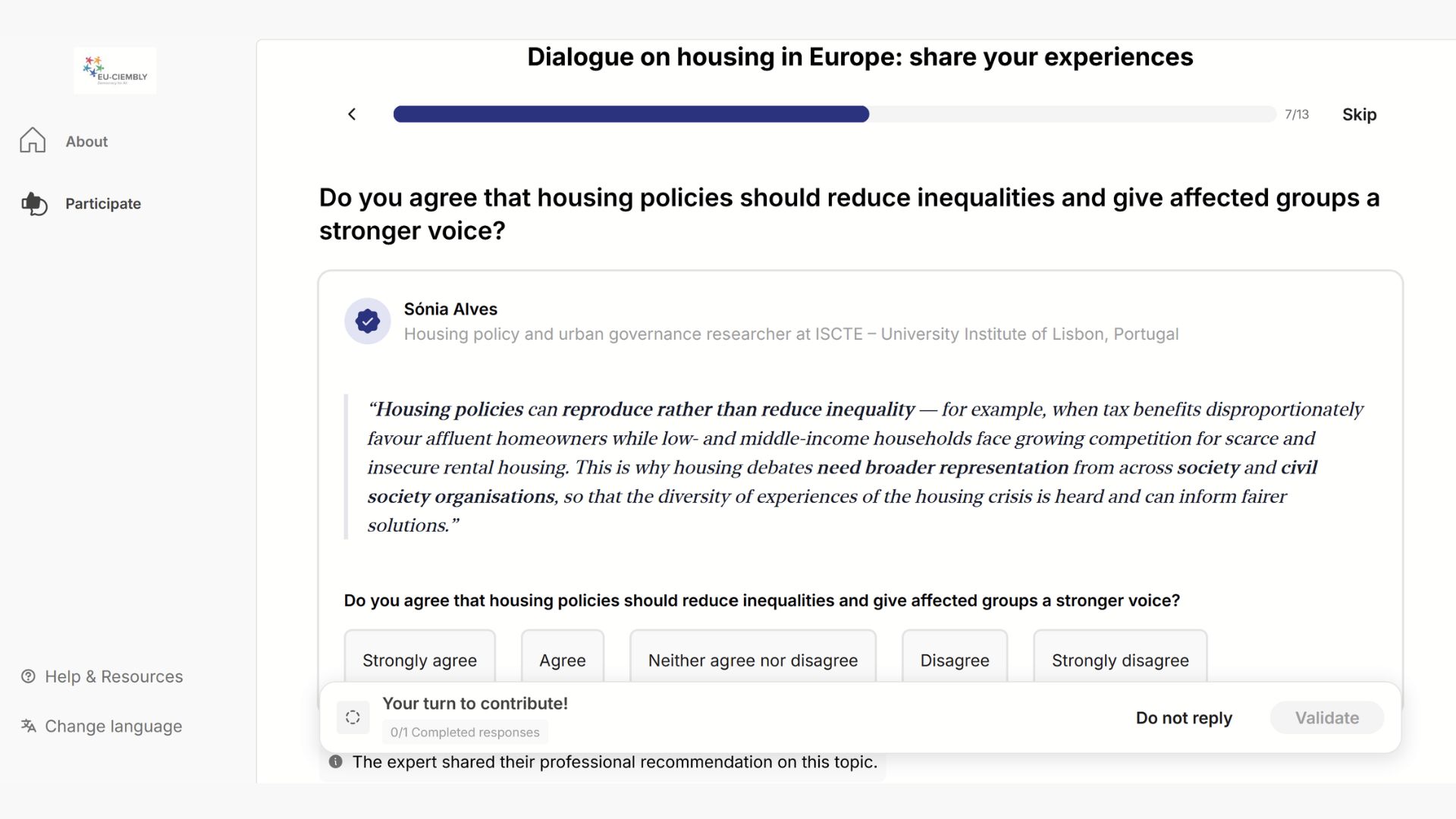
The Dialogue is designed to make citizens’ experiences an essential part of the democratic process. Rather than starting with policy solutions, it starts with the people who experience housing challenges themselves.
By sharing experiences and perspectives, participants can help identify who is most affected by housing exclusion and inequality, what barriers people encounter and what changes could make a meaningful difference.
The Dialogue is also an opportunity to contribute to a wider European conversation. The ideas and priorities emerging from citizens will inform the deliberations of the Transnational Citizens’ Assembly, connecting online participation with a deeper process of citizen deliberation.
👉Share your experience and contribute to the Dialogue
What is EU-CIEMBLY?
EU-CIEMBLY – Creating an Inclusive European Citizens’ Assembly – is an international research project funded by the European Union’s Horizon Europe programme.
The project brings together civil society organisations, academic institutions and European partners to develop and test a new model of Citizens’ Assembly. Its central ambition is to make democratic participation more inclusive, equal and representative, particularly for people whose voices are too often absent from decision-making processes.
EU-CIEMBLY combines research, evaluation and real-world pilots to develop a prototype that can eventually be adapted at European, national and local levels. Ultimately, the project seeks to strengthen citizens’ influence over decisions that affect their lives.
👉Find out more about the EU-CIEMBLY project
From local experiments to a European conversation
The transnational Dialogue is the latest step in a series of EU-CIEMBLY pilots designed to test how Citizens’ Assemblies can become more inclusive.
The project first tested its model through a local pilot in Colchester, bringing together 50 residents and students to discuss housing challenges affecting the city and the University of Essex community. This was followed by a national pilot in Cyprus, where 60 residents from across the country came together to develop proposals on housing issues.
Building on these experiences, the Transnational Citizens’ Assembly brings the conversation to the European level. Citizens from EU Member States will explore housing exclusion, inequality and access, with particular attention to the experiences of those most affected by the housing crisis.
Two digital tools support this process. Dialogue provides a space where citizens can share experiences, engage with ideas and identify priorities before the Assembly. Panoramic, an AI-supported knowledge base, helps participants explore trusted project materials before and during the Assembly.
👉Register here to join the transnational Citizen Assembly!
Make.org: technology supporting participation
As a partner in EU-CIEMBLY, Make.org brings its experience in participatory democracy and civic technology to the project. We provide the technological tools that support the Citizens’ Assemblies. A key part of this work is our multilingual platforms, which enables citizens to participate online, share their experiences, respond to proposals and help identify priorities ahead of the Transnational Citizens’ Assembly.
Stay tuned for more updates as we continue to work on these exciting developments and bring more voices into the democratic process. You can follow our updates on our LinkedIn or Facebook page.