


A Europe-wide dialogue
To support the work of the Young Citizens Assembly, citizen perspectives were collected through two complementary participation tools.
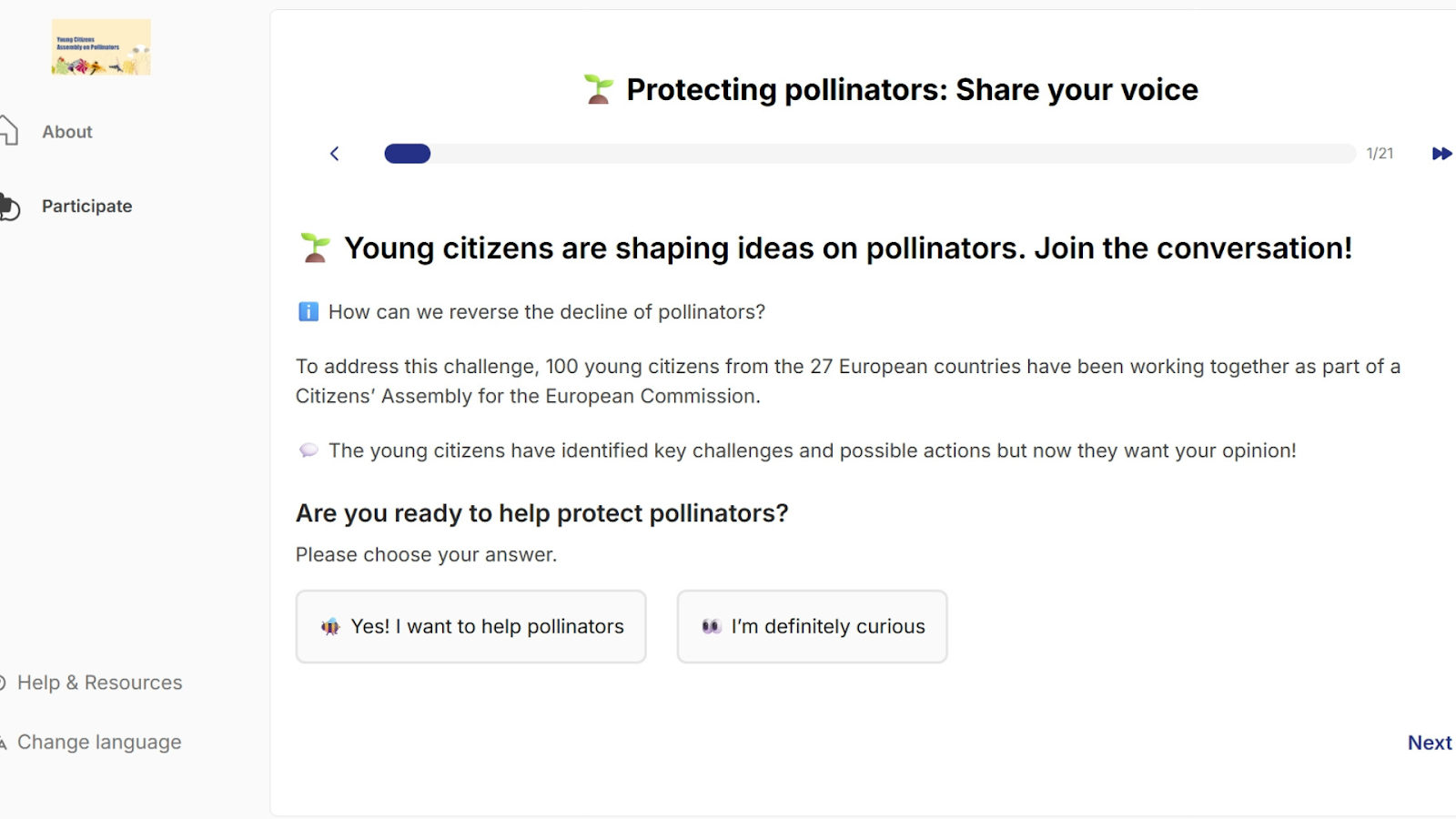
The Public Dialogue Platform developed by Make.org enabled Assembly members to ask questions directly to citizens and receive feedback on their recommendations. This was a pioneering experience as Dialogue had never before engaged the Assembly members and the broader public so well. As a result, the Make.org platform engaged 6,169 participants, generating more than 26,000 votes and 15,500 comments. This input provided valuable insights into citizens’ perceptions of pollinator decline and the solutions they believe should be prioritised.
In parallel, the European Commission operated its Citizens’ Engagement Platform, open from June 2025 to February 2026, which collected contributions from across Europe. These submissions were analysed thematically to identify key priorities, even though the discussions were not initiated by the Assembly members themselves.
High concern and willingness to act
Participants expressed strong concern about the decline of pollinators and its consequences for ecosystems, agriculture, and food security.
Many citizens also demonstrated a willingness to take action in their everyday lives. Participants reported planting pollinator-friendly plants, reducing meat consumption, choosing seasonal and local products, and supporting local producers.
At the same time, respondents emphasised that protecting pollinators requires more than individual efforts. Many highlighted the need for stronger political leadership, effective enforcement of environmental rules, and financial support for farmers transitioning to more sustainable practices. Education and accessible information were also identified as essential for enabling long-term behavioural change.
Reducing pesticides and transforming agriculture
Across the dialogue, pesticides emerged as the most frequently identified cause of pollinator decline. A large majority of participants supported stricter EU regulation of pesticide use. Many also emphasised the need to develop and adopt natural or biological alternatives.
Agriculture and land use were also seen as key levers for change. Participants widely criticised intensive agricultural practices, monocultures, and overproduction for their negative impacts on pollinators and ecosystems.
Instead, citizens called for more diverse, organic, pesticide-free and local farming systems, supported by fair economic incentives for farmers. Habitat restoration was also highlighted as crucial, including the creation of flower strips, hedges, trees, and green spaces in both rural and urban environments.
Contributing to the Assembly’s work
The insights gathered through Make.org’s dialogue have helped broaden the perspectives informing the Young Citizens Assembly on Pollinators. By connecting structured deliberation with open citizen participation, the initiative has created a valuable exchange between Assembly members and citizens across Europe.
As the Assembly finalised its recommendations, these contributions help ensure that the proposed solutions reflect both public concerns and practical experiences from across the continent.
For the first time ever, Make.org’s Dialogue platform was used for a project, supported by the European Commission. We are glad it turned out to be a successful collaboration with impressive engagement results.