

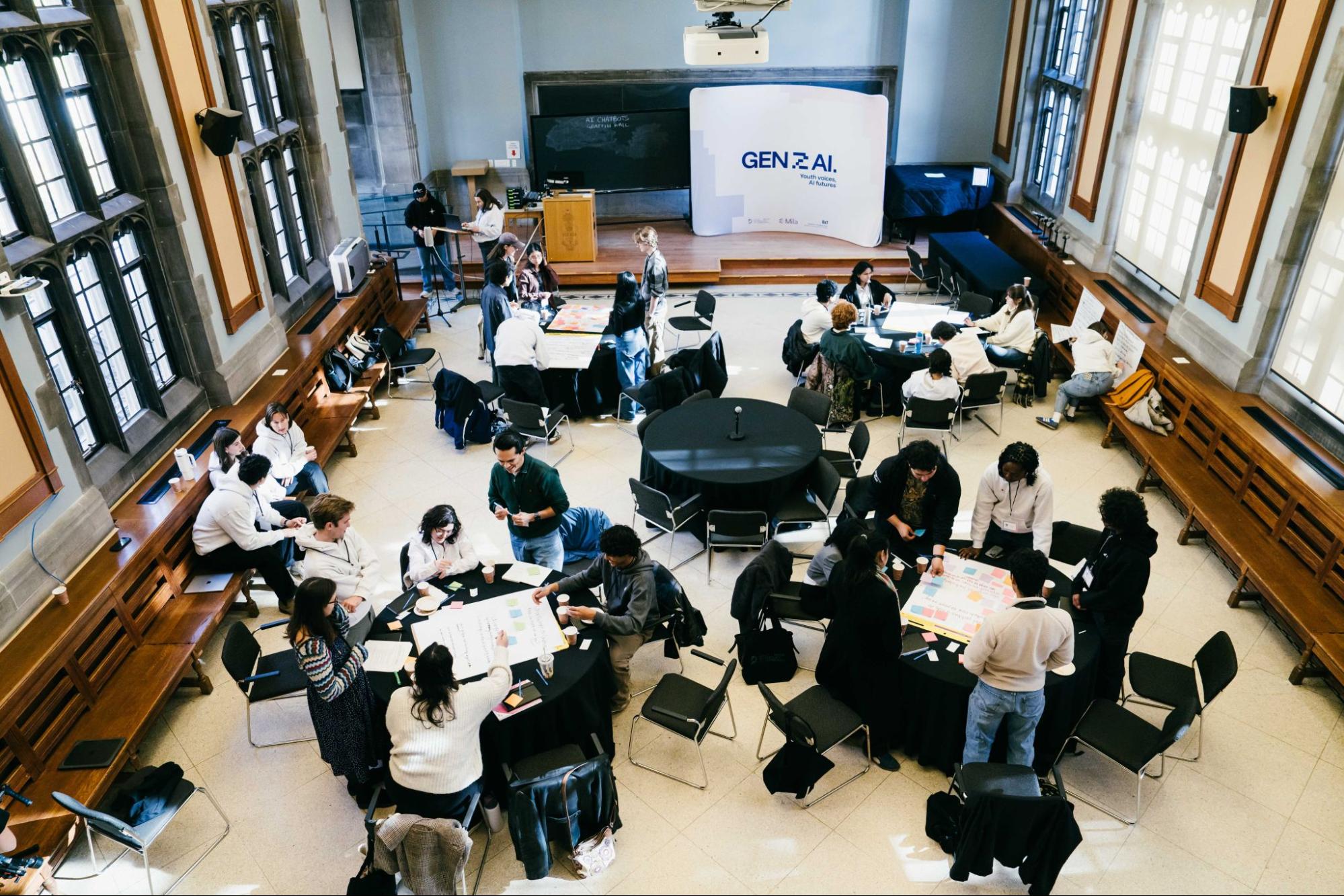
A platform that compliments the in-person Youth Forums
In early November, Gen(Z)AI gathered 100 young Canadians, aged 17 to 23, in Toronto to deliberate on AI chatbots.Their recommendations now move from subgroup discussions to a broader public space, the Make.org platform, where they can be enriched, prioritized, and refined.
Two interactive sequences guide participants through this exploration. Each addresses one of the Youth Forum’s central concerns: the impact of AI chatbots on mental health and safety, and the growing risks to critical thinking in a world where AI is increasingly integrated into daily life.
“AI Chatbots and You: Help Us Protect Mental Health and Safety”
The first sequence invites people to react to the concerns raised by Gen(Z)AI participants about emotional dependence, social isolation, and mental health issues surrounding AI chatbots. Then, three drafted policy recommendations are opened to public scrutiny:
1/ Regulating addictive AI chatbot design
2/ Creating transparent reporting and flagging
3/ Establishing a new government body for AI safety
Participants can indicate their level of agreement with these recommendations and suggest improvements: a crucial step in refining each proposal. The sequence closes with two open spaces: one for sharing personal stories related to their use of AI Chatbots, and another for proposing other AI issues they believe deserve more attention.
“Don’t Let AI Do All the Thinking: Share your ideas to make AI chatbots safer for everyone”
This second sequence explores a different but just as pressing concern: whether increasing reliance on AI is affecting our critical thinking. As AI chatbots assist with more and more tasks, how do we preserve the ability to reason, learn, and collaborate without overly depending on these systems? Participants are asked to judge how important it is to act on the risk of cognitive offloading, the habit of letting chatbots think, decide, or remember information for us.
Then again, two recommendations drafted during the first Youth Forum are presented for feedback:
1/ Simple opt-out options
2/ Supporting AI literacy and public involvement in AI decision-making
Again, participants rate these proposals and contribute suggestions to refine their scope and ambition. This second sequence ends with space for participants to describe how chatbots have affected their learning or problem-solving skills, and to highlight other issues (like AI and jobs, bias and discrimination or how AI affects the environment) that should remain on the national agenda.
Three more in-person Youth Forums are planned between January and April 2026, and each will be followed by a new moment for Canadians to share their views on the recommendations from the previous Forum.
A participatory process strengthened by technology
Soon, Make.org’s role will be to capture, structure, and analyse this collective intelligence. Each contribution, whether a vote, an open comment, or a story, will feed into a rigorous process led by our team of sociologists and data scientists. The aim is to ensure that the final recommendations presented at the plenary in April 2026 reflect a balanced synthesis of insights from the representative Youth Forum, contributions from young people across Canada, and expert perspectives.
The platform is out today, check it out here*!
Gen(Z)AI is presented by the Centre for Media, Technology and Democracy and the Dialogue on Technology Project (DoT) at SFU's Morris J. Wosk Centre for Dialogue, in partnership with Mila - Quebec Artificial Intelligence Institute. This project is funded by The Waltons Trust, CIFAR , and Ronald S. Roadburg Foundation.
*Please note only Canadians aged between 17 and 23, as well as Canadian experts can contribute. Any other contribution will not be taken into consideration.